
Diamond Hones vs Whetstones
Diamond hones and whetstones both sharpen knives effectively, but they work differently and suit different situations. This guide compares speed, edge quality, maintenance, cost, and which is better for guided sharpening systems.
Salvatore Emma
6/10/20265 min read
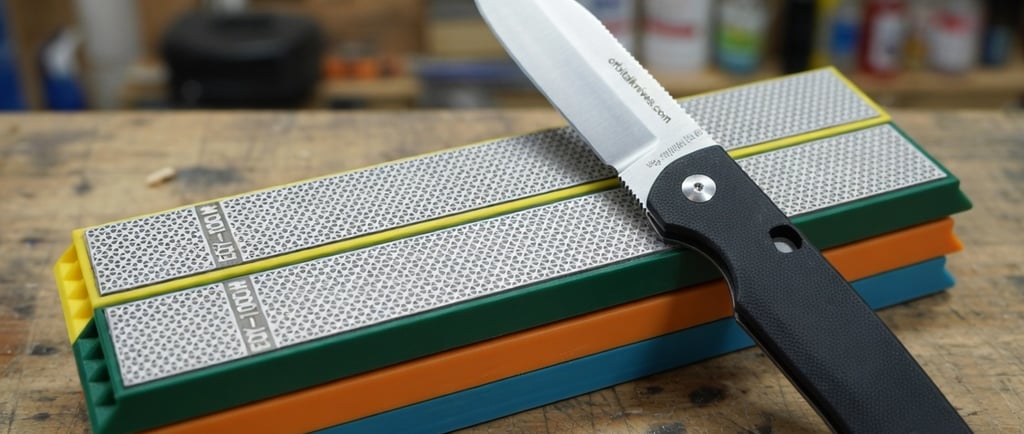
Diamond Hones vs. Whetstones: Which Is Better for Sharpening Knives?
Ask ten knife sharpeners whether diamond hones or whetstones are better, and you'll get ten different opinions — usually strong ones. The honest answer is that neither is universally better. They work differently, excel in different situations, and the right choice depends on what you're sharpening, how often, and what you want out of the process.
This guide covers how each works, where each wins, what they cost over time, and which makes more sense for a guided sharpening system.
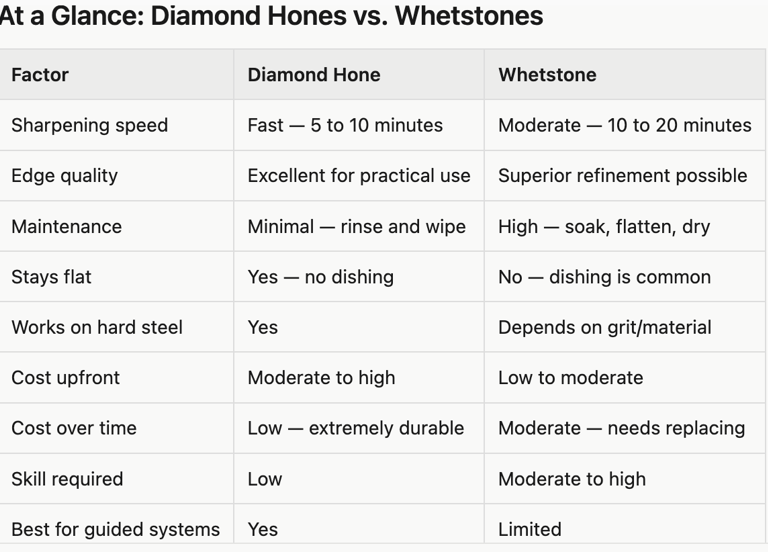
At a Glance: Diamond Hones vs. Whetstones
FactorDiamond HoneWhetstoneSharpening speedFast — 5 to 10 minutesModerate — 10 to 20 minutesEdge qualityExcellent for practical useSuperior refinement possibleMaintenanceMinimal — rinse and wipeHigh — soak, flatten, dryStays flatYes — no dishingNo — dishing is commonWorks on hard steelYesDepends on grit/materialCost upfrontModerate to highLow to moderateCost over timeLow — extremely durableModerate — needs replacingSkill requiredLowModerate to highBest for guided systemsYesLimited
How Diamond Hones Work
Diamond hones use industrial diamonds — the hardest naturally occurring material on Earth — bonded to a flat metal or plastic substrate. Each stroke removes metal via direct abrasion: the diamonds cut the steel, not grind it. No slurry builds up the way it does on a whetstone. No soaking required.
According to Sharpening Supplies, diamond stones come in two primary surface types: continuous (solid diamond surface, better for fine work) and interrupted (perforated pattern, reduces swarf buildup and works faster on coarser grits). Most systems use interrupted surfaces for coarse and medium stages, and continuous for fine and polishing.
The practical advantages are significant:
Speed. Diamond cuts faster than any other abrasive material. A knife that takes 20 minutes on a whetstone takes 5–10 on diamond.
No maintenance. No flattening, no soaking, no drying protocol. Rinse under water, wipe dry.
Stays flat permanently. Whetstones dish with use — the center wears faster than the edges. Diamond hones maintain their flat surface across their entire lifespan.
Works on any steel. Diamond cuts carbide, ceramic, and the hardest super steels. A whetstone's effectiveness drops off on very hard alloys.
How Whetstones Work
Whetstones are blocks of abrasive material — aluminum oxide, silicon carbide, or natural stone — that remove metal by abrading the blade surface as it passes over. Unlike diamond, the stone itself wears during sharpening, releasing fresh abrasive particles in a process called "swarf." This self-refreshing quality is part of what gives whetstones their reputation for producing particularly refined edges.
Knives and Tools notes that the term "whetstone" simply means a stone used to whet (sharpen) a blade — it has nothing to do with water specifically, though modern Japanese water stones are the most common type in use today.
Whetstones require more care:
Most need soaking in water for 5–15 minutes before use
They dish (develop a concave surface) with regular use and must be flattened periodically using a diamond plate or lapping film
They dry out between sessions and can crack if stored improperly
Grit labeling isn't standardized — one brand's "fine" is another brand's "medium"
The payoff for that maintenance is a highly refined edge finish. Japanese water stones in the 3000–8000 grit range produce a mirror polish that diamond typically can't replicate without purpose-built finishing hones.
Edge Quality: The Real Comparison
This is where the debate gets nuanced. Seriously Fast Sharpening's 2026 comparison puts it plainly: "Diamond for speed, whetstone for finesse."
Diamond leaves a slightly more aggressive scratch pattern at equivalent grit levels. The edge is sharp and functional — most home cooks and EDC users will never notice the difference — but under magnification, a diamond-sharpened edge has slightly more micro-serration than the same grit on a quality Japanese water stone.
For everyday kitchen knives, hunting knives, and EDC folders, a diamond-sharpened edge at fine grit (600–1200) performs exceptionally well. For a custom chef's knife where someone wants a mirror-polished, near-surgical edge, a progression through high-grit whetstones (3000–8000) or finishing stones produces a meaningfully superior result.
Most serious sharpeners use both: diamond for the coarse and medium stages (fast material removal, bevel setting), and a fine whetstone for the finishing progression. This combines the speed of diamond with the refinement of stone.
Lifespan and Long-Term Cost
Diamond hones are extremely durable. The diamonds themselves are bonded to the substrate, and quality hones maintain their cutting ability for years of regular home use. BladeForums members report decade-plus lifespans on quality DMT-style diamond plates with moderate use. The surface does gradually wear — diamonds detach or polish down — but the process is slow.
Important caveat: new diamond hones go through a brief break-in period where they feel more aggressive. Sharpening Supplies notes this is normal and resolves after the first few sharpening sessions as protruding diamonds wear to a consistent height.
Whetstones wear faster because the abrasive material is consumed during use. Quality Japanese water stones in the 1000–3000 range typically last 3–5 years with regular home use before they become too thin or uneven to flatten reliably. Cheaper stones wear even faster.
The total cost picture over 10 years generally favors diamond for anyone sharpening multiple knives regularly.
Grit Selection: What to Use When
Both diamond hones and whetstones follow the same progression principle: coarser grits remove more metal and repair damage, finer grits refine the edge.
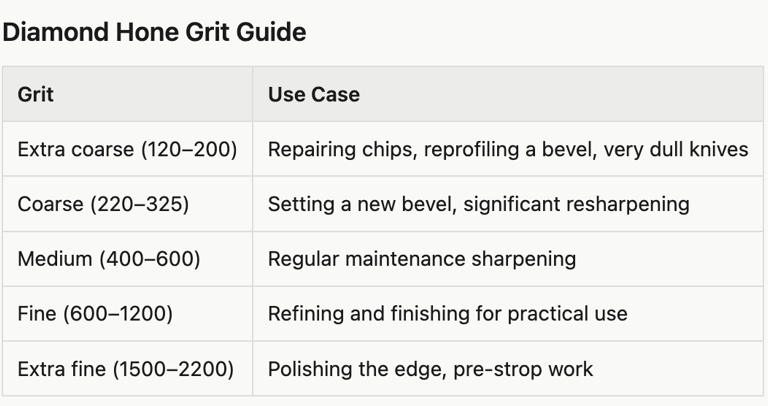
Diamond Hone Grit Guide
GritUse CaseExtra coarse (120–200)Repairing chips, reprofiling a bevel, very dull knivesCoarse (220–325)Setting a new bevel, significant resharpeningMedium (400–600)Regular maintenance sharpeningFine (600–1200)Refining and finishing for practical useExtra fine (1500–2200)Polishing the edge, pre-strop work
For most home sharpeners, a medium and fine diamond hone covers 90% of situations. Coarse is useful for rescue work on neglected knives or establishing a new bevel angle. Extra fine is a finishing touch before stropping.
The SureAngle diamond hone set is designed to cover the full progression for the SAM sharpening system — giving you the grit range you need for everything from initial bevel setting through final edge refinement in one compatible set.
Diamond Hones and Guided Systems: A Natural Fit
This is the practical consideration that tips the balance decisively toward diamond for anyone using a guided sharpening system.
Guided systems depend on a flat abrasive surface. When the stone dishes, the contact geometry changes — meaning the angle you set on the guide no longer matches the angle actually being sharpened. A dished whetstone in a guided system silently undermines the whole point of using a guide in the first place.
Diamond hones stay flat. Every stroke sharpens at the angle you set, session after session. No flattening required, no geometry drift from an uneven surface. Sharpening Supplies confirms this is one of the primary reasons diamond stones are preferred for guided and clamp-based systems: consistent flatness means consistent results.
For the SureAngle SAM system, this matters especially — the parabolic guide is engineered to correct angle drift from tip to heel, but that precision only works when the abrasive surface itself is reliably flat. Diamond hones guarantee that.
Which Should You Choose?
Choose diamond hones if:
You want fast results with minimal setup and cleanup
You use a guided sharpening system
You're sharpening EDC, kitchen, or hunting knives to a practical working edge
You want a low-maintenance tool that lasts for years
You're a beginner who doesn't want to manage stone care
Choose whetstones if:
You want to develop freehand sharpening as a skill
You're pursuing a mirror-polished, highly refined edge on a premium knife
You enjoy the process and ritual of traditional sharpening
You're finishing an edge after diamond or powered sharpening
Use both if:
You want speed through the coarse and medium stages and refinement through the fine and polishing stages
You maintain a mix of working knives and high-end pieces
For most people sharpening real-world knives at home — kitchen sets, EDC folders, hunting knives — diamond hones deliver better results with less effort and less ongoing cost. The whetstone advantage in edge refinement is real but irrelevant for most practical cutting tasks.
The Bottom Line
Diamond hones win on speed, maintenance, longevity, flatness, and compatibility with guided systems. Whetstones win on maximum edge refinement and the satisfaction of a traditional process. For guided sharpening, diamond isn't just convenient — it's the technically correct choice.
If you want to get the most out of a guided system like the SureAngle SAM sharpener, pair it with quality diamond hones and you have a complete, low-maintenance sharpening setup that delivers consistent results across every knife you own.
See the SureAngle diamond hone set →
Want to understand the angle side of sharpening? Read: What Knife Sharpening Angle Should You Use? New to guided sharpening? Start here: How to Sharpen a Knife Correctly
Sure Angle Parabolic Sharpening System
Sharpness Perfected
Contact
Newsletter
support@sureangle.com
(941) 800-2152
© 2026. All rights reserved.