
How to Sharpen a Knife
Most knives go dull not from heavy use, but from one fixable mistake: an inconsistent sharpening angle. This guide breaks down how to sharpen a knife correctly, what angle to use, and how to get professional results at home every time.
Salvatore Emma
6/10/20266 min read
How to Sharpen a Knife Correctly (And Keep the Angle Consistent)
Dull knives are one of the most common kitchen frustrations — and one of the most preventable. The surprising truth: most knives go dull not because they're used a lot, but because they're sharpened incorrectly, or not at all. The single biggest factor in a sharp, long-lasting edge is angle consistency. Get the angle right, keep it consistent from tip to heel, and your knives will perform like they're brand new.
This guide covers everything you need to know: what angle to use, how to hold it, the tools available, and how to know when you're actually done.
Table of Contents
Sharpening vs. Honing: What's the Difference?
These two terms get used interchangeably, but they describe completely different processes.
Sharpening removes material from the blade to create a new edge. It's what you do when a knife has lost its edge entirely, or when the bevel needs to be reset. You use an abrasive tool — a whetstone, diamond hone, or guided sharpening system — to grind away metal and form a fresh apex.
Honing realigns the existing edge without removing significant material. Over time, the thin metal at the edge of a blade rolls or folds to one side, which makes it feel dull even though the bevel is intact. A honing rod or steel straightens that edge back into alignment. Serious Eats describes honing as "maintenance" and sharpening as "repair" — a useful mental model.
The takeaway: Hone regularly (before or after each use). Sharpen only when honing stops restoring the edge. Sharpening too often removes metal unnecessarily and shortens your knife's lifespan.
What Angle Should You Use?
The sharpening angle is the angle at which you hold the blade against the abrasive surface. Most references give a "per-side" angle, meaning a 20° angle creates a 40° total edge.
Here's a practical breakdown by knife type:
Knife TypeRecommended Angle (per side)Japanese kitchen knives10–15°Western/German kitchen knives17–22°EDC / pocket knives17–22°Hunting / field knives22–30°Cleavers and heavy work blades25–30°+
The general rule: a lower angle produces a sharper but more fragile edge, ideal for slicing. A higher angle produces a more durable, chip-resistant edge, better for heavy cutting and outdoor use. Smith's Consumer Products recommends matching your angle to the knife's intended use rather than picking a single universal angle.
One important note: when manufacturer specs say a knife comes sharpened at 15°, that means each side. You need to match that angle when resharpening or you'll grind away metal pointlessly before the new edge takes over.
How to Maintain a Consistent Angle
This is where most home sharpeners fall apart. You can have the right angle set at the center of the blade and lose it completely by the time the hone reaches the tip or heel. Inconsistency means a blade with multiple micro-bevels stacked on top of each other — dull in practice even after sharpening.
There are two main approaches:
Freehand Sharpening
Freehand sharpening on a whetstone is a skill that takes significant practice to master. You hold the blade at your target angle and draw it across the stone while maintaining that position by feel. The challenge: the angle changes as your wrist rotates and your elbow moves. BladeForums veterans recommend using a permanent marker on the bevel to track where metal is actually being removed — a useful diagnostic, but not a solution for the beginner.
Guided Sharpening Systems
Guided systems use a physical clamp and rod to set the angle mechanically, removing the guesswork. The blade is clamped in place, the hone rides along a guide rod, and you get a repeatable angle on every stroke. This is the right approach for anyone who wants professional results without years of practice.
However, there's a geometry problem most people don't know about.
Standard center-mounted guided systems (like the Lansky) create a trigonometric issue: the guide rod pivots from a fixed central point. At the center of the blade, you get your exact set angle. But as the hone moves toward the tip or heel, the rod must reach a more distant contact point from that fixed pivot — which flattens the rod and produces a shallower angle, often 3–5° less than intended. Lansky's own instructions acknowledge this by recommending you reposition the clamp for longer blades.
The SureAngle SAM system solves this with a patent-pending parabolic rod guide. Instead of a straight pivot path, the curved guide adjusts the rod's effective direction dynamically as you move along the blade. The parabola is mathematically chosen so the angle stays nearly constant from tip to heel — one pass, no repositioning. It's the only guided system on the market designed specifically to correct this geometric flaw.
Best Tools for Sharpening a Knife at Home
Whetstones
The gold standard for freehand sharpening. A dual-sided stone (like the King Whetstone, recommended by Serious Eats) covers coarse and fine grit in one tool. Requires technique and practice to use well. Best for experienced sharpeners who want full control.
Pull-Through Sharpeners
Fast and easy, but they use preset V-shaped carbide slots that grind both sides simultaneously at a fixed angle. They remove a lot of metal quickly and can't be adjusted for different knives. Fine for knives you don't care about. Not recommended for quality blades.
Electric Sharpeners
Faster than whetstones and more consistent than pull-through tools. Higher-end models offer adjustable angles. They can be aggressive on metal removal and are expensive. Best for someone who sharpens frequently and wants speed.
Guided Rod Systems
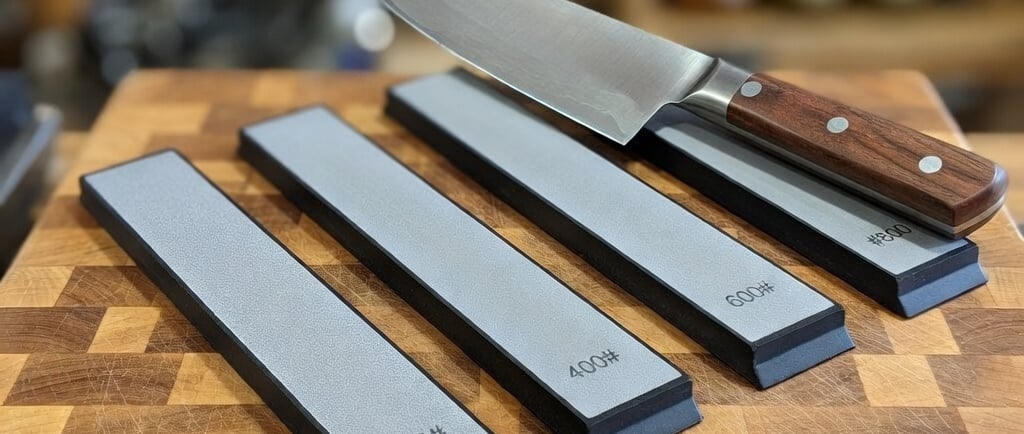
The best balance of consistency and accessibility for home sharpeners. A quality guided system with diamond hones lets you hit a precise, repeatable angle without years of freehand practice. The SureAngle diamond hone set is compatible with the SAM system and covers the full grit progression from coarse to fine. Visit sureangle.com/shop to see the full lineup.
How to Test If Your Knife Is Sharp
There are three reliable tests you can do at home:
1. The Paper Test
Hold a sheet of printer paper by the top edge and draw the knife downward through it. A sharp knife slices cleanly. A dull one tears, catches, or deflects. This is the most common home test and works well for kitchen knives. Outdoors Stack Exchange rates this among the most reliable non-body tests.
2. The Tomato or Onion Test
A sharp knife bites into a tomato skin without pressure and slices through cleanly. If you have to push down to pierce the skin, the edge is dull. This test mimics actual kitchen use and is more practical than the paper test for kitchen knives.
3. The Fingernail Test
Lay the blade flat on your thumbnail and gently push the edge forward (never across). A sharp edge catches immediately and doesn't slide. A dull edge slides across the nail without gripping. Knife Aid notes this is a reliable tactile test, though it takes some practice to read accurately.
Skip the arm-hair-shaving test for safety reasons. It's dramatic but unnecessary when the paper and nail tests tell you everything you need to know.
How Often Should You Sharpen Your Knives?
This depends on how often you cook and how well you maintain the edge between sessions. The general guidance:
Home cooks (a few times per week): Sharpen 2–4 times per year. Hone before every use.
Daily home cooks: Sharpen every 1–2 months. Hone daily.
Professional kitchen use: Sharpen weekly or more. Hone before every service.
Bob's Red Mill points out that regular honing dramatically reduces how often you need to sharpen — because you're keeping the edge aligned before it fully folds over. Think of honing as brushing your teeth and sharpening as going to the dentist.
Why Does My Knife Go Dull So Fast?
If your knives seem to dull faster than they should, one of these common culprits is almost certainly responsible:
Using the dishwasher. Heat, harsh detergents, and metal-on-metal contact in the dishwasher are blade killers. Always hand-wash and dry knives. Bacher Tools lists this as the single most damaging everyday habit.
Using a hard cutting surface. Glass, ceramic, marble, and stone countertops destroy edges on contact. Use wood or plastic cutting boards only.
Storing knives loose in a drawer. The edges bang against other utensils with every drawer open and close. Use a magnetic strip, knife block, or blade guard.
Inconsistent sharpening angles. This is the silent killer. If you sharpen at a different angle each time, you're stacking micro-bevels instead of sharpening a single one. The result: a blade that sharpens quickly but goes dull just as fast. TSPROF identifies angle inconsistency as one of the top reasons for rapid edge loss.
Twisting the blade while cutting. Levering the knife to pop food apart or prying open anything applies lateral stress that rolls and chips the edge. Let the blade do the cutting — straight in, straight out.
The Bottom Line
A sharp knife is safer, faster, and more enjoyable to use than a dull one — and getting there is simpler than most people think. The fundamentals: know your target angle, maintain it consistently from tip to heel, and hone regularly between sharpening sessions.
For home sharpeners who want professional results without the freehand learning curve, a quality guided system removes the guesswork. The SureAngle SAM sharpening system was designed specifically to solve the angle inconsistency problem that every other guided system ignores — keeping your edge precise across the full length of the blade, every time.
Explore the SureAngle SAM system at sureangle.com →
Have questions about the SureAngle system? Visit the product support page for assembly videos, instructions, and FAQs.
Sure Angle Parabolic Sharpening System
Sharpness Perfected
Contact
Newsletter
support@sureangle.com
(941) 800-2152
© 2026. All rights reserved.