
Lansky Style Sharpeners vs Sure Angle (What the instructions don't tell you)
The Lansky is a well-made guided sharpener — but its instructions skip over one important limitation: the angle changes from blade center to tip and heel. Here's what's actually happening, and what the SureAngle SAM system does differently.
Salvatore Emma
6/10/20266 min read
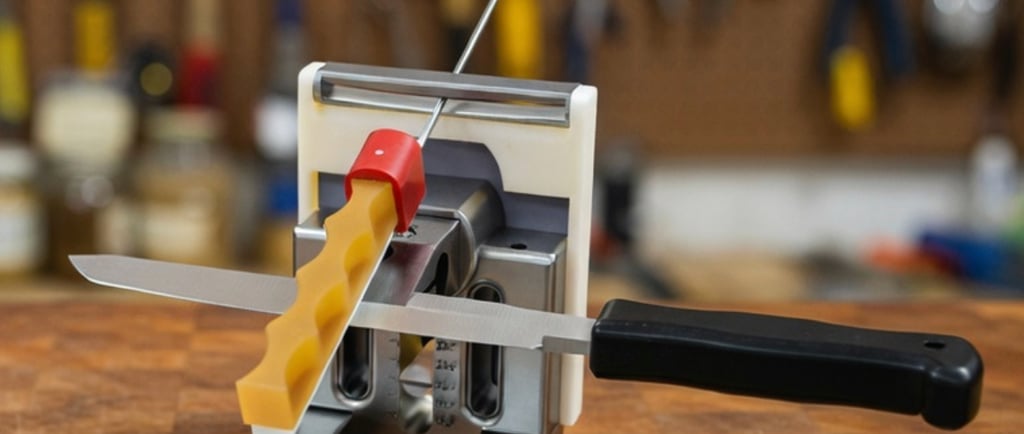
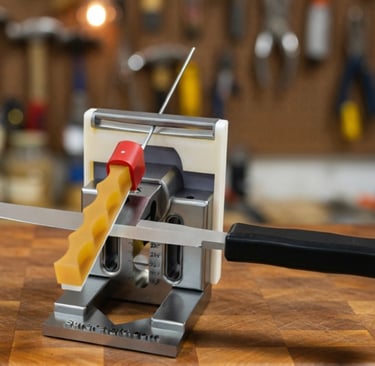
Lansky vs. SureAngle: What the Instructions Don't Tell You
The Lansky sharpening system has been a genuine entry point into precision sharpening for decades. It's affordable, widely available, and genuinely works — millions of people have sharpened knives with it and walked away satisfied. If you're here to read something that trashes Lansky, this isn't it.
What this article covers is something Lansky's instructions don't explain: a geometry limitation built into the design that affects every standard center-clamp rod-guided sharpener, and what the SureAngle SAM system does to solve it.
If you already own a Lansky and have noticed your bevel looks uneven — wider in the middle, narrower at the tip and heel — you're seeing this limitation in action. If you're shopping for a guided sharpener and wondering whether the Lansky is the right choice, this comparison will help you decide.
How the Lansky Works (and What It Does Well)
The Lansky system works by clamping the knife's spine at a fixed point, then guiding a hone along the blade at a pre-set angle. The guide rod passes through one of several angle-indexed holes (17°, 20°, 25°, or 30°), which sets the sharpening angle mechanically. You hold the hone at that angle and draw it from tip to heel — or heel to tip — without needing freehand technique.
What it delivers:
Repeatable angles that most beginners couldn't maintain freehand
A full grit progression from extra coarse (70 grit) through extra fine (1000 grit) in the Deluxe 5-stone kit
Compact design that stores easily and travels well
Low cost of entry — the standard kit costs $40–$50, and even the diamond-stone upgrade version stays under $80
For someone who has never sharpened a knife with any kind of control before, the Lansky is a significant improvement over guessing at angles on a bench stone or running a knife through a pull-through sharpener. It's good. That's worth saying plainly.
What the Instructions Don't Mention
Here's what Lansky's instructions tell you to do: attach the clamp to the spine of the knife at the center of the blade, tighten it down, select your angle, and sharpen.
Here's what the instructions don't explain: the angle you set at the center hole is the angle you get at the center of the blade. The moment the hone moves toward the tip or heel, that angle changes.
The reason is geometry. The guide rod pivots from the clamp — a single fixed point at the center of the blade's spine. When the hone is directly over the clamp, the angle triangle is clean: the rod, the blade, and the bench form the exact angle you selected. Move the hone toward the tip and the rod now has to reach a more distant contact point from the same fixed pivot. The horizontal distance increases while the vertical height stays fixed. In right-triangle terms, the arctangent decreases — the angle flattens.
This plays out visibly as bevel width variation. BladeForums users have documented it directly: "the bevel seems to be wider in the middle of the knife." That wider bevel at center and narrower bevel at tip and heel is the geometric angle change made visible in metal.
The effect is more pronounced on:
Longer blades (the hone travels farther from the pivot)
Blades with significant distal taper (the blade thins toward the tip, making the geometry change faster)
Kitchen knives in the 6–8 inch range, where tip-to-center distance is substantial
The Repositioning Workaround (And Why It's Incomplete)
Lansky's own official instructions acknowledge this issue implicitly. For longer blades, the instructions recommend moving the clamp to different positions along the blade and sharpening each section separately.
This is a real solution in the sense that it reduces the angle drift at any single clamp position. But it introduces a different problem: each clamp position creates its own small angle, and where three zones meet, you have transition points with slightly different bevel geometries overlapping. The edge isn't one consistent surface — it's a stitched-together approximation of one.
The Kitchen Knife Forums community has an active thread specifically about upgrading from Lansky for this reason. The consensus among more experienced sharpeners is that the Lansky is a solid starting point that most users eventually outgrow when they develop the awareness to notice what a truly consistent edge feels and performs like.
The Oil Stone Issue
Standard Lansky kits ship with alumina oxide oil stones — a reliable but older abrasive technology. Oil stones require honing oil as a lubricant to float swarf off the surface and prevent the stone from glazing over. This means you need to keep oil on hand, wipe down the stone and blade after use, and deal with the mess that comes with any oil-based process.
Lansky does offer a diamond version (the 4-stone diamond kit, around $60–$70). The diamond hones are faster, require only water as lubricant, stay flat, and work on harder steels. If you're buying a Lansky, the diamond version is the better choice — but it's still the same center-pivot design with the same geometric limitation.
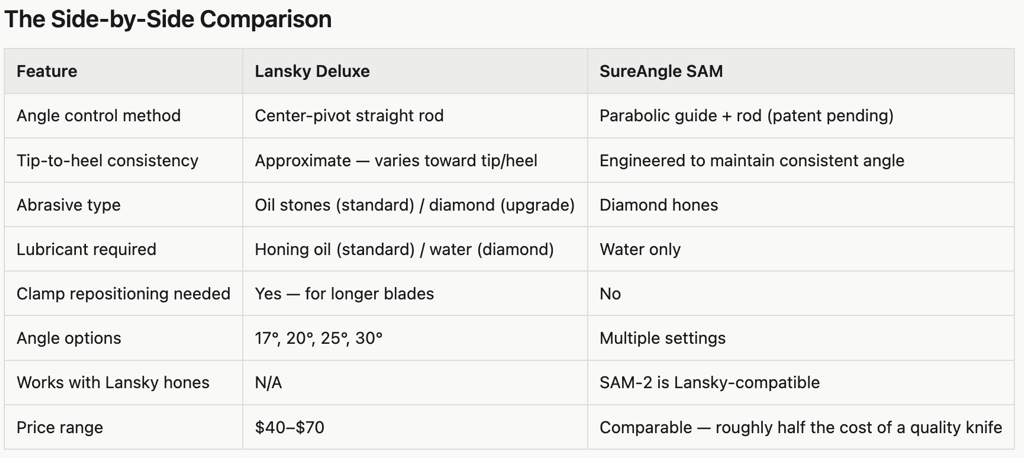
The Side-by-Side Comparison
FeatureLansky DeluxeSureAngle SAMAngle control methodCenter-pivot straight rodParabolic guide + rod (patent pending)Tip-to-heel consistencyApproximate — varies toward tip/heelEngineered to maintain consistent angleAbrasive typeOil stones (standard) / diamond (upgrade)Diamond honesLubricant requiredHoning oil (standard) / water (diamond)Water onlyClamp repositioning neededYes — for longer bladesNoAngle options17°, 20°, 25°, 30°Multiple settingsWorks with Lansky honesN/ASAM-2 is Lansky-compatiblePrice range$40–$70Comparable — roughly half the cost of a quality knife
What the SureAngle SAM Does Differently
The SureAngle SAM system starts with the same guided-sharpening concept: clamp the knife, set an angle, draw the hone. But it changes the core engineering of the guide mechanism.
Standard guided systems use a straight pivot path — the rod slides through a straight hole, so the geometry changes linearly as the hone moves along the blade. The SureAngle SAM uses a patent-pending parabolic guide that curves in a way calculated to compensate for the right-triangle geometry change as the hone moves from center toward the tip and heel. The parabola adjusts the rod's effective direction at each point along the blade so the contact angle stays nearly constant across the full edge length.
The result is one pass, one angle, from tip to heel — without repositioning the clamp, without dividing the blade into zones, without stacking inconsistencies over multiple sessions.
As SureAngle's own description puts it: "the further the hone is from the center of the blade, the shallower the edge angle becomes. Our patent-pending parabolic rod guide minimizes the angle delta from tip to heel."
The system was engineered by Salvatore Emma Jr., a serial inventor and former CEO of a publicly traded medical technology company, who identified this problem after years of working with standard guided sharpeners on quality kitchen and hunting blades. Read the full story here.
The SAM-2: The Lansky-Compatible Bridge
One detail worth highlighting for existing Lansky owners: the SureAngle SAM-2 is specifically designed to be compatible with Lansky hones. If you've already invested in Lansky's diamond or ceramic hones, you don't need to replace them to move to the parabolic guide system. The SAM-2 lets you keep your existing abrasives and upgrade the geometry.
For anyone starting fresh, the full SAM kit includes diamond hones matched to the system's guide geometry — giving you the complete setup from one purchase.
Which Should You Choose?
The Lansky makes sense if:
You're new to guided sharpening and want a low-cost starting point
You're sharpening short EDC blades (3 inches or less) where tip-to-heel drift is minimal
You already own a Lansky and your knives are sharp enough for your purposes
The SureAngle SAM makes more sense if:
You're sharpening kitchen knives, hunting knives, or any blade over 4 inches
You've had a Lansky and noticed inconsistent bevel width across the blade
You want a guided system that delivers what all guided systems promise: true angle consistency, tip to heel
You own quality knives worth maintaining properly
You want diamond hones from the start rather than the oil stone default
The Bottom Line
The Lansky is a legitimate sharpener that has introduced millions of people to guided precision sharpening. The angle consistency it offers compared to freehand technique or a pull-through is real and meaningful — up to a point.
That point is the center of the blade. Beyond it, toward the tip and heel, the angle shifts — and Lansky's own instructions acknowledge this with the multi-position repositioning guidance, even if they don't explain the geometry behind it.
The SureAngle SAM was built specifically to solve this. It keeps what works about guided sharpening and replaces the one element that has always compromised consistent results: the straight pivot path that makes tip-to-heel angle consistency geometrically impossible.
For anyone serious about a consistent edge across the full length of their blade, that difference is the whole ballgame.
Explore the SureAngle SAM system → | Use code WELCOME15 for 15% off
Want to understand the geometry in more detail? Read: The Hidden Geometry Problem in Guided Knife Sharpeners Comparing abrasive options? Read: Diamond Hones vs. Whetstones: Which Is Better? New to sharpening? Start here: How to Sharpen a Knife Correctly
Sure Angle Parabolic Sharpening System
Sharpness Perfected
Contact
Newsletter
support@sureangle.com
(941) 800-2152
© 2026. All rights reserved.