
The Best Knife Sharpening System for Home Cooks (an Honest Guide)
The best knife sharpening system for a home cook depends on how often you cook, what knives you own, and how much consistency you want. This guide covers every sharpener type honestly — electric, pull-through, whetstone, and guided — so you can choose the right one.Blog post description.
Salvatore Emma
6/10/20268 min read
The Best Knife Sharpening System for Home Cooks (An Honest Guide)
There is no single best knife sharpening system for every home cook. The right choice depends on how often you cook, what kind of knives you own, and how much you care about edge quality. A home cook who makes dinner three times a week and owns a $40 knife set has different needs than someone who spent $200 on a Japanese chef's knife and uses it daily.
What all home cooks share: they need a sharpener that's consistent, easy to use, and won't damage the knives they're trying to maintain.
This guide covers every major type of sharpening system honestly — what each one does well, where each falls short, and which situations each suits best. No affiliate incentives, no filler picks.
The 5 Types of Knife Sharpening Systems
Before getting into specifics, here's a plain summary of the options:
Pull-through sharpeners — cheap, fast, damaging over time
Electric sharpeners — fast and easy, but aggressive metal removal
Whetstones — best edge quality, steepest learning curve
Honing rods — maintenance only, not sharpening
Guided sharpening systems — precise, consistent, low skill required
Most home cooks own a pull-through sharpener or a honing rod and mistake one for the other. Neither sharpen a blade the way a stone or guided system does.
What to Look For in a Home Sharpening System
Before choosing a system, consider these four factors:
Angle consistency. The most important element in sharpening is holding the same angle stroke after stroke. Most sharpening problems — uneven bevels, edges that dull quickly, knives that look sharp but don't cut cleanly — come from inconsistent angles during the sharpening process.
Metal removal rate. More isn't better. Removing more steel gets a knife sharp faster but shortens its lifespan. Sharpening should remove only what's needed to reset the edge.
Compatibility with your knives. Japanese knives are typically sharpened at 12–15° per side. German/Western knives at 15–20°. A sharpener that forces a fixed angle on every knife may be actively damaging the ones designed for a different geometry, as Seriously Fast Sharpening notes.
Ease of use. The best sharpener is the one you'll actually use. A $300 system collecting dust on a shelf won't keep your knives sharp.
Pull-Through Sharpeners: Convenient but Costly
Pull-through sharpeners are the most common sharpener in home kitchens — two angled carbide or ceramic rods mounted in a plastic housing that you drag your knife through. They're cheap ($10–$40), require no technique, and feel like they work because a couple of passes will bring a dull knife back to a serviceable edge.
The problem is how they achieve that edge. Carbide pull-through sharpeners work by removing metal aggressively, scraping metal off both sides simultaneously at a fixed angle. Under magnification, the edge looks jagged and irregular. They're effective at temporarily restoring a working edge and almost nothing else.
More importantly, most pull-through sharpeners use a fixed angle, typically 20°. If your Japanese chef's knife was designed to be sharpened at 15°, every session in the pull-through is reshaping it toward a geometry it wasn't designed for. Professional sharpeners consistently report that pull-through sharpeners are the most common cause of damaged blade geometry they see in knives brought in for repair. A knife sharpened at the wrong angle repeatedly won't hold an edge normally — it'll be sharp for a day and dull quickly.
Pull-through sharpeners are fine for: cheap knives, serrated bread knives (some versions), or a quick touch-up when nothing else is available.
Pull-through sharpeners are wrong for: any knife worth keeping, Japanese steel, or anything you've spent real money on.
Electric Sharpeners: Fast, but Know the Trade-Off
Electric sharpeners use motorized abrasive wheels or belts to grind a new edge onto the knife. The best ones, like the Chef's Choice 15 Trizor XV (around $160) and the Tormek T-1 (~$250), produce genuinely excellent edges and are highly regarded by Bon Appétit, America's Test Kitchen, and professional reviewers.
The advantages are real: fast results (2–3 minutes per knife), no skill required, and consistent angles across multiple passes. High-end electric sharpeners like the Chef's Choice 15 have guided slots that set the angle mechanically.
The trade-off is metal removal. Electric abrasive wheels remove more steel per pass than hand sharpening methods, which shortens the lifespan of a knife over years of use. This matters more on expensive knives and less on everyday working blades. For a home cook with a standard kitchen set and no particular attachment to edge refinement, a quality electric sharpener is a solid choice.
The other limitation is angle flexibility. Most electric sharpeners have one or two preset angles. If you own a mix of Western knives (20°) and Japanese knives (15°), a single-angle electric sharpener will handle one category correctly and the other less so.
Electric sharpeners are best for: home cooks who want fast, low-effort results and cook frequently enough to use the investment. Best on standard Western-style knives.
Electric sharpeners aren't ideal for: high-end Japanese knives, cooks who want maximum control over edge geometry, or anyone who sharpens infrequently enough that the upfront cost doesn't make sense.
Whetstones: The Best Edge, the Steepest Climb
Ask any professional sharpener what produces the best edge and the answer is almost always a whetstone progression. Japanese water stones in particular are capable of producing polished, refined edges that no other method matches.
What they require is practice. A lot of it.
Freehand sharpening on a whetstone demands that you maintain a consistent angle across the full length of the blade using nothing but muscle memory and tactile feedback. Getting there takes time — most people need 10–20 serious sharpening sessions before their freehand technique becomes reliably consistent. Until then, results are unpredictable.
Whetstones also need maintenance: they dish with use and must be periodically flattened. Most water stones require pre-soaking. They're harder to use on a kitchen counter than a guided system because nothing holds the knife in position.
For a home cook who enjoys the process — who wants sharpening to be a meditative skill they develop over time — whetstones are a deeply satisfying choice and produce the best results. For a home cook who wants sharp knives without a new hobby, they're probably not the right starting point.
Whetstones are best for: cooks who want to develop freehand sharpening as a skill, anyone pursuing maximum edge quality on premium knives, or a finishing stage after guided or electric sharpening.
Whetstones aren't ideal for: beginners who want consistent results immediately, cooks who sharpen infrequently, or anyone not willing to invest time in technique.
Honing Rods: Maintenance, Not Sharpening
This is worth clarifying because honing rods come with most knife sets and are often described as "sharpeners." They aren't.
A honing rod — whether smooth steel, ceramic, or diamond-coated — realigns the microscopic edge of the blade. Over time and with use, the thin apex of a knife's edge bends and deforms slightly. Running the blade along a honing rod straightens it back. This makes a knife that has begun to feel slightly dull cut more crisply again.
Honing doesn't remove meaningful amounts of metal. It doesn't create a new edge. When a blade is genuinely dull — when the apex has worn away — no amount of honing will fix it. It needs actual sharpening.
A honing rod used between sharpening sessions extends the time between sessions significantly and is worth doing regularly. It replaces sharpening until it can't, and then you sharpen.
Guided Sharpening Systems: Precision Without the Learning Curve
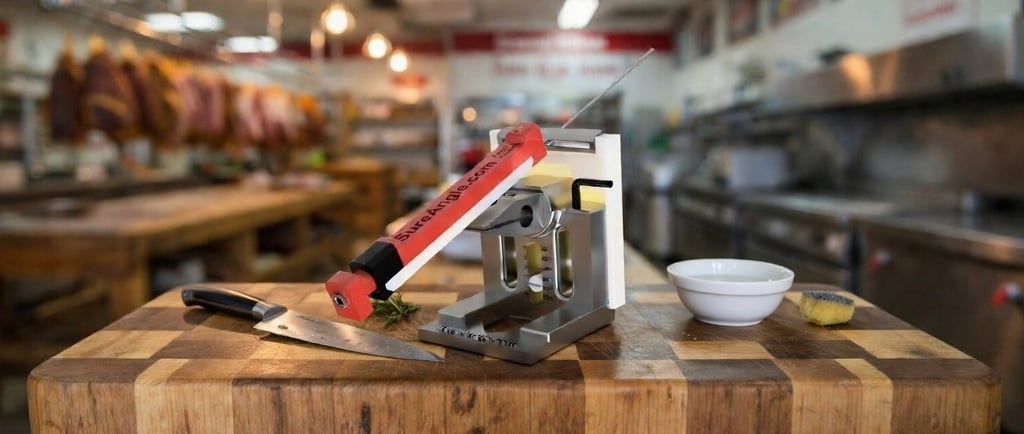
Guided sharpening systems — rod-guided or clamp-based designs — hold the blade at a fixed angle while you draw an abrasive stone along the edge. Because the angle is controlled mechanically, not by feel, results are consistent from the first session. No freehand technique required.
This is the category that sits between electric sharpeners (fast, some precision) and whetstones (slow, maximum precision). A well-executed guided system session produces edge quality close to skilled freehand whetstone work, at a pace not far from electric — and it gives you control over the angle you set, which matters if you own a mix of knife styles.
The most widely known guided systems are Lansky ($30–$60), KME ($100), and Edge Pro ($200 and up). All work on the same fundamental principle: clamp the knife, set the guide rod to an angle, draw the hone across the blade.
The limitation common to all standard guided systems is a geometry problem that most buyers never hear about. Because the guide rod pivots from a center-mounted clamp, the actual sharpening angle changes as the hone moves toward the tip and heel of the blade. The pivot point is fixed; the contact point moves. The result is that a 20° setting at the center may be 16–17° by the time the hone reaches the tip. For short blades, this matters less. For longer kitchen knives, the effect is visible in the bevel — wider in the center, narrower at the extremes.
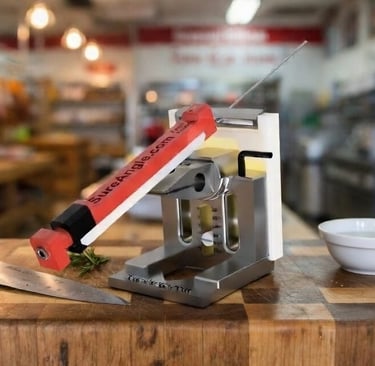
This is the problem the SureAngle SAM system was specifically engineered to solve. Instead of a straight pivot path, the SAM uses a patent-pending parabolic guide that corrects for the changing geometry dynamically as the hone moves along the blade. The result is a consistent angle from tip to heel — which is what guided sharpening is supposed to deliver, and what standard center-pivot designs don't quite achieve on full-length kitchen knives.
At a price point roughly equivalent to a quality dinner out — significantly less than the cost of the knives it maintains — the SAM is designed for home cooks who want precision sharpening without years of freehand practice. Use code WELCOME15 at sureangle.com for 15% off.
Guided systems are best for: home cooks who want consistent, repeatable precision across a variety of knives, anyone who owns quality blades worth maintaining properly, or cooks who want control over edge geometry without mastering freehand technique.
Guided systems aren't ideal for: cooks who sharpen so rarely that setup time isn't worthwhile, or anyone who only owns a single cheap knife.
The Quick Decision Guide
If you...Best fitWant the fastest possible touch-up and own budget knivesPull-through (accept trade-offs)Cook daily and want low-effort consistent resultsElectric (Chef's Choice 15 or similar)Want to develop sharpening as a skill and get the best edgeWhetstone (commit to the practice)Own quality knives and want precise control without techniqueGuided system (SAM or equivalent)Already sharpen — want to extend time between sessionsHoning rod, used regularly
One More Thing: Sharpening Frequency
Home cooks tend to sharpen too rarely. The recommendation from most knife professionals is to hone before or after each significant use and sharpen 2–4 times per year depending on usage. Cooks who hone regularly can often extend sharpening intervals longer.
The test is simple: hold the knife at eye level and look at the edge. If you see light reflecting off the edge apex — a thin shiny line — the edge has rolled and needs honing. If honing doesn't restore the cutting feel, it's time to sharpen.
Maintaining a sharp knife is easier than restoring a dull one. A 10-minute session on a quality system before edge degradation compounds is faster and better for the knife than a 30-minute recovery session once it's genuinely dull.
The Bottom Line
For most home cooks, a guided sharpening system hits the best balance of precision, control, ease of use, and edge quality. Electric sharpeners are a legitimate alternative for cooks who prioritize speed and simplicity. Whetstones are the right choice if you want sharpening to be a skill you master. Pull-through sharpeners aren't worth using on any knife you care about.
The one thing all the options above have in common: any of them, used consistently, will keep your knives sharper than the kitchen drawer.
Explore the SureAngle SAM system →
Want to understand sharpening angles? Read: What Knife Sharpening Angle Should You Use? Curious why standard guided sharpeners have an angle consistency problem? Read: The Hidden Geometry Problem in Guided Knife Sharpeners New to sharpening? Start here: How to Sharpen a Knife Correctly
Sure Angle Parabolic Sharpening System
Sharpness Perfected
Contact
Newsletter
support@sureangle.com
(941) 800-2152
© 2026. All rights reserved.