The Knife Sharpening Angle Problem Nobody Talks About
Most guided knife sharpeners have a hidden geometric flaw that changes the sharpening angle from heel to tip — and most people never realize it's happening. This guide explains what knife sharpening angle actually means, why consistency matters, and how a parabolic guide solves the problem that rod-guided systems can't..
Salvatore Emma
6/3/20266 min read
What Is a Knife Sharpening Angle?
The sharpening angle is the angle between the blade face and the sharpening surface, measured per side. Most knives have a bevel on both sides. When someone says "sharpen at 20°," they mean each side gets ground to 20°, creating a total included angle of 40° at the edge. [Source: Sharpening Supplies](https://www.sharpeningsupplies.com/blogs/articles/detailed-discussion-on-knife-sharpening-angles)
The smaller the angle, the thinner and sharper the edge — but also the more fragile. The larger the angle, the more durable the edge, but the less it slices cleanly. Both numbers matter. The balance between them is what makes a knife feel either surgical or like a butter knife after a month.
There are two separate things happening when you sharpen:
1. Setting the bevel — establishing the physical geometry of the edge
2. Refining the edge — removing the wire/burr and polishing the apex
Both require the same angle. If they don't match, you're creating a micro-bevel at best and a rounded, blunted edge at worst.
---
Why Angle Consistency Is Everything
You can have the right angle and still ruin a knife. The issue isn't just what angle you choose — it's whether you hold that angle consistently across the entire blade, from heel to tip, on every single pass.
Here's what inconsistency actually does:
- Creates an uneven bevel — wider in some sections, narrower in others
- Leaves the edge with multiple competing micro-bevels that don't meet cleanly at the apex
- Results in a knife that feels sharp off the stone but dulls within days
- Causes the tip to feel sharper or duller than the middle and heel — because it often is
[BladeForums users have documented exactly this](https://www.bladeforums.com/threads/lansky-uneven-bevel.1762530/): after sharpening with popular angle-guided systems, the bevel appears wider in the middle of the blade — a direct symptom of angle drift. This isn't a user error. It's a physics problem built into how most guided sharpeners work.
The bottom line: the angle is the foundation. Everything else — grit, stroke count, honing — sits on top of it. A shaky foundation produces a shaky edge, every time.
---
The Hidden Flaw in Rod-Guided Sharpeners
This is the part most sharpening guides skip over, and it's the most important thing to understand if you use a clamping, rod-guided sharpener like a Lansky, KME, or similar system.
Here's the geometry problem: in a rod-guided system, the honing stone attaches to a straight rod that slides through a guide mounted on the blade spine. The angle is set by where the rod clips into the guide — say, 20°. The assumption is that 20° stays 20° all the way from heel to tip.
It doesn't.
As you move the stone from the heel toward the tip, the effective angle at the blade changes because the geometry of the blade is not a simple flat plane. The blade has a curved belly. The knife tapers in both height (distal taper) and thickness. As a straight rod traces this curve, the angle at the contact point shifts. [Kitchen Knife Forums members with professional sharpening backgrounds confirm the drift is 1–3 degrees on a typical knife, and worse on longer blades with more pronounced bellies.](https://www.kitchenknifeforums.com/threads/what-are-the-current-recommendation-for-guided-sharpening-systems.81582/page-3)
The result: the heel gets sharpened at one angle, the belly at a slightly steeper angle, and the tip at yet another angle. The edge looks sharpened. The bevel looks even to the naked eye. But under magnification — or after two weeks of real use — the compound bevel reveals itself.
This is why so many people sharpen with a guided system and still end up with a knife that cuts fine for a few days, then goes dull again faster than expected. The apex never fully aligned across the whole blade.
---
Knife Sharpening Angles by Knife Type
Not every knife wants the same angle. Here's a practical reference guide based on intended use:
Japanese chef's knife | 10°–15° | Hard steel, precision slicing |
Western/German chef's knife | 17°–20° | Softer steel, needs more support |
|EDC pocket knife | 18°–22° | Daily abuse, needs durability |
|Hunting/skinning knife | 20°–25° | Heavy work, bone contact possible |
|Filleting knife | 12°–17° | Flex and precision over durability |
Tactical/survival knife | 22°–30° | Batoning, prying, hard use |
Cleaver | 25°–30° + | Impact resistance, not slicing |
Sources: [TSPROF](https://tsprof.us/blogs/news/knife-sharpener-angle-guide) | [Noblie Custom Knives](https://nobliecustomknives.com/knife-sharpening-angle-guide-quick-chart-for-beginners/) | [Dauntless Manufacturing](https://dauntlessmanufacturing.com/blogs/news/how-to-sharpen-a-knife)
The key takeaway: match the angle to the job. A hunting knife sharpened at 12° per side will chip on bone. A chef's knife sharpened at 25° per side will push food instead of slice it.
---
15° vs 20°: Which Angle Is Right for You?
This is the most common question, and the honest answer is: it depends on the steel and the task.
15° per side (30° inclusive):
- Best for Japanese knives (harder steel, HRC 60+)
- Exceptional slicing performance
- Less forgiving — chips faster under lateral stress
- Needs more careful maintenance
20° per side (40° inclusive):
- Best for Western-style kitchen knives, EDC blades, outdoor knives
- Better edge retention under real-world use
- Slightly less acute, but holds up to cutting boards, bone, and field work
- The "sweet spot" for most people
The bigger issue isn't which angle you pick — it's picking one angle and sticking to it consistently, every pass, from heel to tip. A perfect 15° on one side and a drifted 17° on the other side produces a knife with an off-center apex that never cuts as well as it should. [Source: Knife Steel Nerds — CATRA edge retention research](https://knifesteelnerds.com/2018/06/18/maximizing-edge-retention/)
---
How to Get a Consistent Angle Every Time
Free-hand sharpening on a whetstone is a skill that takes years to develop. Even experienced sharpeners drift by 1–3° during a session. [Source: Sharpening Supplies](https://www.sharpeningsupplies.com/blogs/articles/5-tips-for-holding-a-consistent-sharpening-angle-and-3-mistakes-to-avoid)
For most people who want a truly sharp knife without a multi-year learning curve, a guided system is the practical answer. The problem — as discussed above — is that most guided systems introduce their own angle error through rod geometry.
There are three realistic options:
1. Free-hand on a whetstone — highest ceiling, steepest learning curve, no mechanical angle drift
2. Clamping rod-guided system — accessible, repeatable angle setting, but angle drifts 1–3° heel to tip
3. Parabolic guide system — corrects the geometric drift that rod systems introduce, delivers consistent angle tip to heel without requiring years of technique
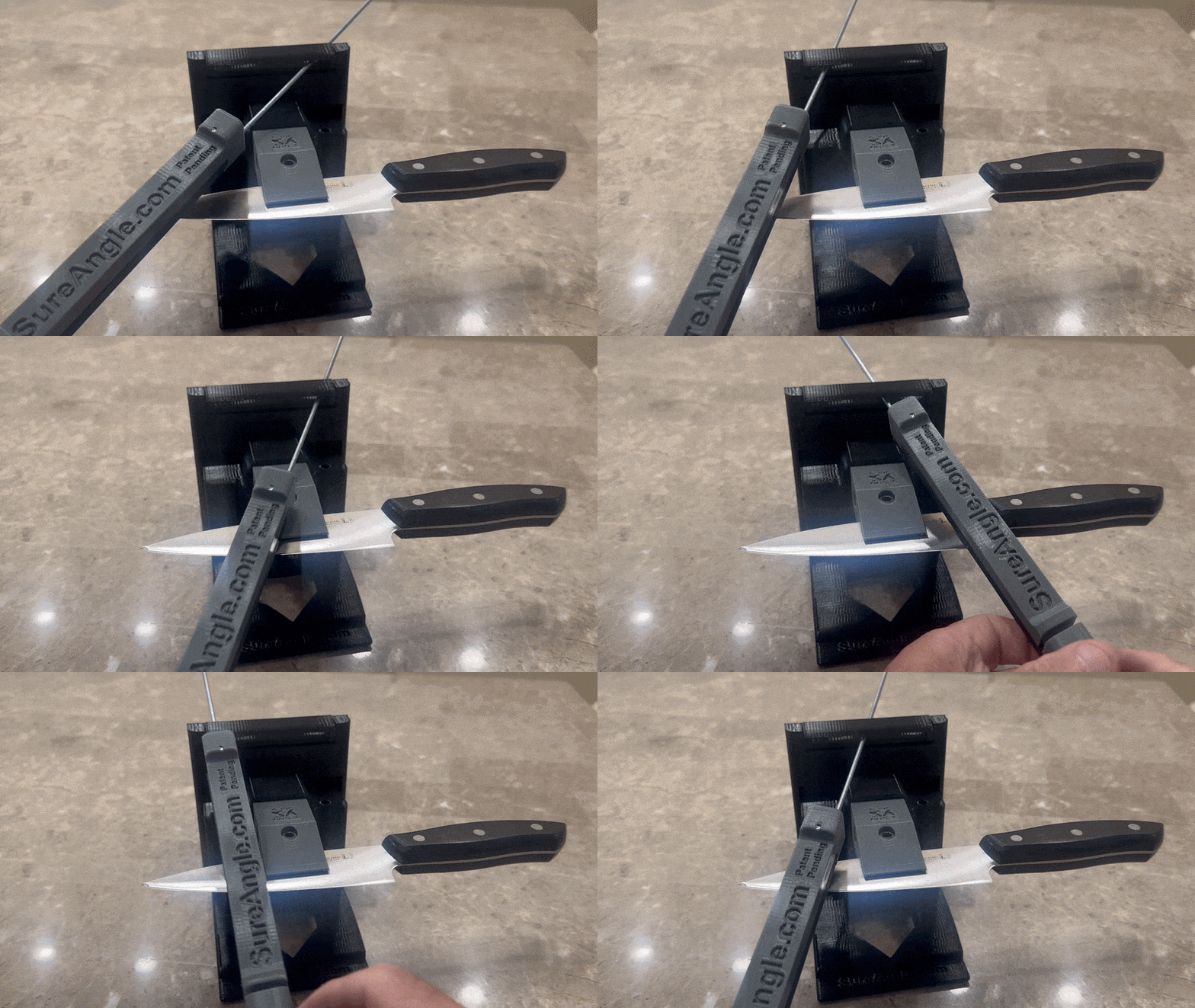
Option 3 is where the SAM system from SureAngle fits. Its patent-pending parabolic guide replaces the straight rod with a guide that compensates for the blade's natural geometry — maintaining a true, consistent angle across the full length of the knife, not just at the heel where the guide is set.
---
What Makes a Parabolic Guide Different
A standard rod-guided sharpener sets the angle at a single pivot point — the clamp on the spine — and assumes a straight line from that point to the edge. But knife edges aren't straight lines. They're curves.
A parabolic guide accounts for this. Instead of a fixed straight rod, the guide follows a parabolic arc that tracks the actual geometry of the blade as the honing stone moves from heel to tip. The effective sharpening angle stays constant. The bevel forms cleanly and evenly. The apex aligns across the entire edge.
The [SureAngle SAM sharpening system](https://sureangle.com/sam-1-sure-angle-sharpening-system) was designed specifically to solve this problem — and it does it at a price point that's roughly half the cost of a quality knife. Inventor Salvatore Emma Jr., a serial engineer and patent holder, identified the geometric flaw in conventional guided sharpeners and built the SAM system to correct it.
The result is an edge that's consistent from heel to tip, every time you sharpen — without requiring you to become a skilled freehand sharpener first.
---
Diamond Hones vs Whetstones
Once the angle problem is solved, the next variable is the abrasive. The two most common options:
Whetstones (water stones/oil stones):
- Wide grit range (200–8000+)
- Very effective for full reprofiles and polishing
- Slower material removal on hard steels
- Require flattening over time as they dish
Diamond hones:
- Cut faster — especially on hard stainless and tool steels
- Stay flat indefinitely — no dressing required
- Available in coarse through ultra-fine grits
- More consistent across the life of the hone
- Better for field sharpening and guided systems where flat surfaces matter
For a guided sharpener like the SAM system, diamond hones are the preferred abrasive. The flat surface ensures the sharpening angle stays true — there's no dish or bow to introduce additional angle variation. SureAngle's [diamond hone set](https://sureangle.com/sure-angle-diamond-hone-set) is designed specifically for use with the SAM system, offering consistent grit across the full honing surface.
---
Conclusion
The knife sharpening angle you choose matters. But the angle you actually achieve — consistently, across every inch of the blade — matters more.
Most rod-guided sharpeners introduce a geometric error that shifts the effective angle as you move from heel to tip. It's not a user mistake. It's a physics problem built into the design. Free-hand sharpening avoids it, but requires years of practice. A parabolic guide system eliminates it mechanically.
If you want an edge that's consistent, repeatable, and razor-sharp without becoming a craftsman first, start with a system that solves the geometry problem at the source. The SAM system from SureAngle does exactly that — and at a price that makes it easy to stay sharp.
[See the SureAngle SAM sharpening system →](https://sureangle.com/shop)
---
Stay Sharp.
Sure Angle Parabolic Sharpening System
Sharpness Perfected
Contact
Newsletter
support@sureangle.com
(941) 800-2152
© 2026. All rights reserved.