
Your blog postThe Hidden Geometry Problem in Every Rod-Guided Knife Sharpener
Every major rod-guided knife sharpener — Lansky, KME, Edge Pro, Wicked Edge — shares a hidden geometry flaw: the angle shifts by 3–5° from center to tip and heel. Here's the trigonometry behind the problem, what it does to your edge, and how a patent-pending parabolic guide solves it.
Salvatore Emma
6/10/20266 min read
The Hidden Geometry Problem in Every Rod-Guided Knife Sharpener
If you've ever used a Lansky, KME, Edge Pro, or similar rod-guided knife sharpener and noticed the bevel looked uneven — wider in the middle, narrower at the tip and heel — you weren't doing anything wrong. You were seeing the physical result of a geometry flaw that's built into the design of virtually every clamp-and-rod sharpening system on the market.
It's not a secret, exactly. The sharpening community has discussed it on BladeForums, Kitchen Knife Forums, and dedicated sharpening sites for years. But it's also not something most manufacturers explain clearly, and it's never been solved — until now.
This article explains what the problem is, why it happens, what it means for your edge, and why a parabolic guide curve is the first engineering solution that actually addresses the root cause.
How Rod-Guided Sharpeners Work (The Basics)
Guided sharpening systems were designed to solve the biggest problem in freehand sharpening: human inconsistency. The premise is straightforward. You clamp the knife in a fixed position, set the guide rod to a specific angle using a calibrated hole or slot, and draw the hone along the blade. Because the rod controls the angle mechanically, the result should be consistent and repeatable — no guesswork, no technique required.
For most people, this is a genuine improvement. Lansky, KME, Edge Pro, Wicked Edge, and Work Sharp all sell guided systems on exactly this premise. The knife stays still, the rod holds the angle, and you get a controlled bevel.
The problem is that "controlled" is only true in the middle of the blade.
The Geometry Problem: What Actually Happens at the Tip and Heel
Here's the physics, explained simply.
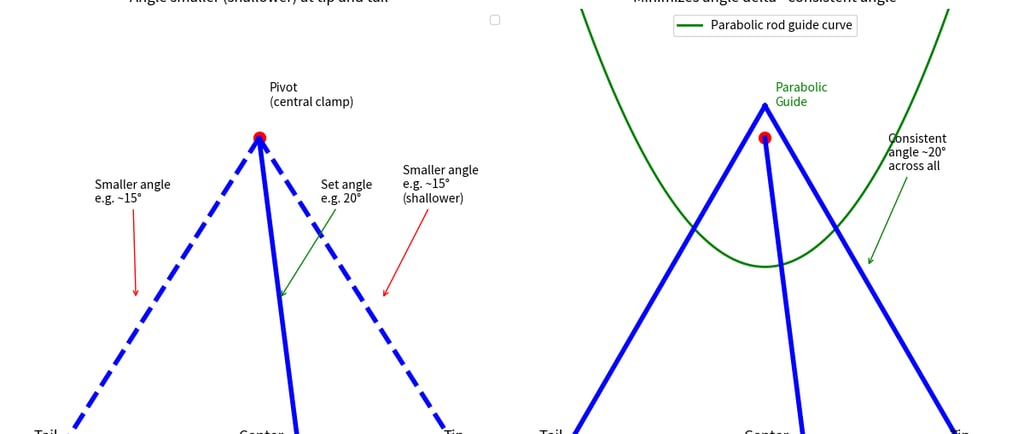
In a standard center-mounted rod-guided system, the guide rod passes through a hole or slot in the central clamp. That clamp sits at a fixed point — roughly the middle of the blade's length. When the hone is at the center of the blade, directly aligned with the pivot point, the geometry is clean: the rod is at exactly the angle you set.
Now move the hone toward the tip.
The rod's pivot is still at the center of the clamp, but the contact point on the blade has moved further away — to the right, toward the tip. The rod must now reach a more distant point from the same fixed pivot. In right-triangle terms: the vertical height (from pivot to edge) stays fixed, but the horizontal run (along the blade toward the tip) increases. That means the angle — the arctangent of height over run — decreases. The rod flattens against the blade.
Move toward the heel and the same thing happens in the opposite direction.
The result: you can set your system to 20°, but by the time the hone reaches the tip or heel of a standard kitchen knife, you may actually be sharpening at 15–17°. Kitchen Knife Forums members have documented this as a 1–3° change on average, with worse drift on longer blades and blades with more distal taper. BladeForums users testing systems like Edge Pro, TSPROF, KME, and Wicked Edge have confirmed the same pattern: "the grinding angle changes if there is a curve to the tip in the blade."
That 3–5° shift is significant. It means the tip and heel of your knife are sharpened to a different angle than the center. The bevel width looks uneven. The edge performance varies along the blade. And after multiple sharpening sessions, you're stacking inconsistencies on top of inconsistencies.
Why Most People Never Realize This Is Happening
There are a few reasons this problem stays hidden.
Most knives aren't long enough to make it obvious. On a short EDC folder (3 inches or less), the angular drift from center to tip is small enough that the practical effect is minimal. The problem becomes pronounced on longer blades — a 6-inch chef's knife, a hunting knife, a fillet blade — where the rod has to reach a much more distant point from the fixed pivot.
Manufacturers acknowledge it without calling it out. Lansky's own instructions say to move the clamp to different positions along the blade for longer knives. That workaround exists precisely because the geometry changes. Most users read this as a setup tip, not as an admission that the angle drifts if you don't reposition.
Slightly varying angles still produce sharp edges. A knife sharpened at 20° in the center and 17° at the tip is still sharp at both points. It just isn't consistently sharp the way a precisely beveled blade is. The performance gap becomes more obvious over repeated sharpening sessions, when the inconsistency compounds.
What This Does to Your Edge in Practice
The visible sign is bevel width variation. If you color your bevel with a permanent marker and make a few passes with a guided system, you'll often see the marker wear away more completely in the center than at the tip or heel. That's the geometry in action — the center is getting more contact, and the edge geometry changes as you move along the blade.
The performance impact shows up as:
Uneven sharpness along the blade. The center cuts cleanly, but the tip or heel may feel slightly duller or catch differently.
Inconsistent edge longevity. Sections with a shallower angle than intended dull faster. Sections with a steeper angle retain their edge longer but don't cut as cleanly.
Difficulty achieving a clean burr at the extremes. Experienced sharpeners who chase a burr from tip to heel often find the burr forms easily at center but requires extra strokes at the extremes — a direct symptom of the angle drift.
The Workarounds Sharpeners Use (And Why They Fall Short)
The sharpening community has developed several workarounds, none of them fully satisfying:
Repositioning the clamp. Lansky recommends this explicitly. Move the clamp to the tip-third of the blade, sharpen that section, then move to center, then to the heel. This reduces the drift at each position but creates a new problem: you now have three slightly different angles meeting at two transition points. The bevel isn't one consistent surface — it's three overlapping ones.
Shortening strokes to the center zone. Some sharpeners avoid the tip and heel entirely, only working the center third of the blade. This produces consistent results in that zone but leaves the rest of the blade underworked.
Accepting the variation. The most common response, particularly among casual sharpeners: just accept that tip-to-heel consistency isn't achievable with a rod-guided system and get on with it. For everyday use on short knives, this is a reasonable position. For anyone who has invested in quality knives and wants to actually protect that investment, it's not.
The Parabolic Solution
The root cause of the problem is a straight pivot path. The rod slides through a straight hole, so the geometry changes linearly as you move along the blade.
The fix is to curve the guide path so it corrects for the trigonometric drift dynamically.
This is the engineering insight behind the SureAngle SAM system. Instead of a straight pivot path, the SAM uses a patent-pending parabolic rod guide — a curved slot whose shape is mathematically calculated to compensate for the changing right-triangle geometry as the hone moves from center toward the tip and heel. The parabola adjusts the rod's effective direction at each point along the blade so the contact angle stays nearly constant across the full edge length.
The result: one pass, one angle, from tip to heel. No repositioning. No three-zone compromise. No stacked inconsistencies across sessions.
The system was developed by Salvatore Emma Jr., a serial inventor and former CEO of a publicly traded medical technology company, after years of frustration with exactly the problem described above. His father — a US Marine and professional butcher — had shown him that a good edge was worth caring about. The parabolic solution came from applying engineering rigor to a problem that the knife world had accepted as simply how guided sharpeners work.
It turns out it didn't have to work that way. Read the full story on the About page.
Why This Matters More Than You Think
If you own one kitchen knife, sharpen it twice a year, and mostly cook at home, the tip-to-heel angle drift from a standard guided system probably won't change your life. Your knife will still be sharp enough.
But if you own quality knives — Japanese carbon steel, high-end chef's knives, precision hunting blades — the drift matters. Those knives are designed to be sharpened to specific angles and to hold those angles. Systematically sharpening the tip and heel at a shallower angle than intended compounds over time, wearing down the geometry the knife was designed around.
And if you've ever wondered why your knife felt like it lost its edge too fast at the tip after sharpening with a guided system — now you know why.
The geometry was never really working the way you thought it was.
The Bottom Line
Rod-guided knife sharpeners are better than freehand sharpening for most people. The angle control they provide is real and meaningful. But the angle consistency they promise — tip to heel — has always been compromised by a fundamental geometric flaw that no one solved until a parabolic guide curve changed the math.
The SureAngle SAM system is the first guided sharpener designed specifically to correct this. If you want to know what truly consistent tip-to-heel sharpening actually feels like, it's worth trying.
Explore the SAM system lineup at sureangle.com →
Want the full angle guide by knife type? Read: What Knife Sharpening Angle Should You Use? New to sharpening? Start here: How to Sharpen a Knife Correctly Questions about the SAM system? Visit the SureAngle support page for assembly videos and instructions.
Sure Angle Parabolic Sharpening System
Sharpness Perfected
Contact
Newsletter
support@sureangle.com
(941) 800-2152
© 2026. All rights reserved.